Brigid
Brigid
I am She
that is the natural
mother of all things,
mistress and governess
of all the elements,
the initial Progeny of worlds,
chief of the powers divine,
Queen of all that are in the otherworld,
the principal of them
that dwell above,
manifested alone
and under one form
of all the Gods and Goddesses.
Lucius Apuleius 125 – 170BC
Brigid (also known as Bríde, Brígid, Bríg, Brigantia), the Exalted One, is the Irish goddess of spring, fertility, and life. It is believed her name comes from the Proto-Celtic work Briganti, which means ‘High One’ or ‘Exalted One.’
As a goddess she has a varied role, being responsible for many different areas of life. Evidence of her is found throughout the ancient texts and in physical form across Ireland and this reflects on how important she was as a goddess in her numerous roles, from protecting mothers and their babies to being the goddess of craftmanship and waterways.
Before we look at her many roles, we should look at her family background and how she is linked to the other Celtic gods and goddesses.
Brigid’s father was the Dagda, the head of the Tuatha Dé Danann and her mother is said to be Danu, a powerful water goddess. Through her father, Brigid had many siblings. The gods Aengus and Midir were her brothers. She married Bres, who was the High King of the Tuatha Dé Danann and she had a son, Ruadán.
There is another version of her family tree which has her married to a man named Tuireann, and with him she bore three sones Brain, Luchar, and Irchaba. This version leads into the tale where the Sons of Tuireann killed Cain, who was the father of Lugh of the Long-Arm, whilst he was transformed into a pig.
However, in the Lebor Gabála Érenn, she is the daughter of Dagda and the wife of Bres, which puts her in a very esteemed position.
The Roles of Brigid
Unlike some of the gods and goddesses, Brigid had multiple roles within mythology. She was known as the goddess of spring, fertility, and life but her role did not end there. She was also a goddess with some contradictions as she was known for her role in life, motherhood, serenity, and water but also related to fire and passion. She is also the inspiration for many of the great writers and poets from Ireland.
Due to her multiple roles, in some traditions Brigid is seem as a triple goddess – three sisters who all have the same name. In this tradition, her roles are split into three distinct parts –
· Poetry and Inspiration – one goddess guiding the tradition of poetry, storytelling, and music, which Ireland is well known for.
· Smithcraft and the Forge – this sister is the patron of blacksmiths, crafts folk, and artisans.
· Healing and Fertility – the most common version of Brigid, guarding over wells, the waterways, herbal medicine, women and childbirth.
Another reason why she may have been ‘split’ into more than one version of herself would be that as a triple goddess she would be able to have different husbands, parents, and children. This would allow for the differing stories that could possibly contradict the existing mythology around her.
Brigid’s role as a fertility and protector goddess was not restricted to humans, but she also acted as a guardian for animals and livestock as well. This is seen in her own animals she kept with her. Her animals are mentioned in the Lebor Galála Érenn, the oldest version of which is from around 1150AD.
The following is translation from there –
‘Brigid the poetess, daughter of the Dagda, she it is who had Fea and Femen, the two oxen of Dil, from whom are named Mag Fea and Mag Femen. With them was Triath, king of the swine, from whom is Thretherne. Among them were heard three demon voices in Ireland after plunder, to wit, whistling and outcry and groaning.
Cirb, king of the wethers, from who is Mag Cirb. With them was Cermna Brecach.
Flidais, from whom is named the kine of Flidais, her four daughters were Ardan and Be Chuille and Danann and Be Tete.
Among the Tuatha De Danann there came shouting and outcry and barking. Shouting for fear of capture, barking against the mischief and plunder, outcry for the fitting lamentation of their affliction.
It is not clear due to the older language but Cirb was a powerful ram, and the King of Sheep.
Imbolc – Brigid’s Sacred Festival
Imbolc is held on February 1st, or sometimes on the night of January 31st, and it marks be midpoint between the winter solstice and the sprint equinox. Imbolc is held as a festival to mark renewal and the first signs of new life after the hardness of winter.
In ancient times, the festival was very important to people who made offerings to Brigid for protection, inspiration, and to honour her.
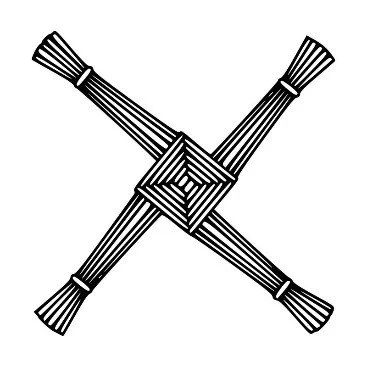
People would weave a Brigid Cross out of straw or rushes and hang it in their homes hoping that Brigid would protect them and their families and provide good fortune in the year to come.
Traditionally, on Imbolc people would –
· Light sacred fires in honour of Brigid’s flame
· Take offerings to holy places and sacred wells, asking Brigid for healing and purification
· Ask Brigid for blessing over their livestock and seeds, in the hope that a good year of farming would follow.
The Death of Brigid’s Son
During her marriage to Bres, Brigid had a son, Ruadán. Ruadán was a child born to a Fomorian father and a Tuatha Dé Danann mother. Brigid’s husband, Bres the Beautiful, was the son of Elathon, a Fomorian prince and although some people disagreed to the union, it was thought that the marriage between the two powerful families could bring peace between the warring tribes. This was, in theory, a nice idea, but in the end, it led to a time of agonising pain for Brigid that no mother should ever have to suffer. The problem with peace deals is that eventually they can break and war begins again.
Ruadán mac Bres gained gifts from both his parents. From this mother, he gained the skills of craftmanship and a fierce protectiveness for his loved ones. From his Fomorian father, he inherited a wild unpredictability from the sea-gods and total loyalty to kin.
The tale of the death of Ruadán is set at a time when the Tuatha Dé Danann ruled using wisdom and magic. The Fomorians were ruled at this time by Balor of the Evil Eye. It was said that Balor was able to kill a hundred warriors with a single glance, which is the reason for his name. There had been an uneasy truce in place for many years, but the Fomorians were getting restless.
The First Battle of Moytura had ended in the truce, but as time passed Lugh Lámfada (Lugh of the Long Arm) had once again united the Tuatha Dé Danann against the Fomorians. Following the first battle, blood lines from both races had become united so now the conflict would not only divide the races but would split family loyalties apart.
For Brigid this was not a good time as she was about to be placed in an impossible position. She was the daughter of the Dagda, the Good God which meant that her loyalty should have been guaranteed to the Tuatha Dé Danann, however, her husband was Fomorian and her son was a mixture of both. Love is a complicated thing and can lead to the ultimate pain.
Eventually tensions rose to the point that war was inevitable and the Second Battle of Moytura began.
Bres sided with his people the Fomorians as honour demanded him to us. Ruadán was a child of both sets of people and so he had a decision to make. The Cath Maige Turied tells us that Ruadán chose to stand with his father and his people. This was a decision that must have cost him dearly emotionally as he was still his mother’s child and so would be fighting against her people who were his tribe.
In some writings it has been suggested that Ruadán felt the need to protect his father as Bres was unpopular with his mother’s people following his short rule where he treated people harshly.
To try and bring the war to a quick conclusion, Ruadán came up with a plan to assassinate the person who was crucial to the success of the Tuatha Dé Danann armies – Goibniu the Smith.
One thing that the Fomorians had noticed was that during battle their weapons became blunted and broken, however, the Tuatha Dé Danann’s weapons never seemed to dull. This was thanks to the skills of Goibniu, also known as the God of Smithcraft and Brewing.
Goibniu had a divine gift when it came to his smithcraft. Every spear that he forged would always find its mark and every sword would cut through enemy armour like butter. Even more importantly, if a person attended one of Goibniu’s feasts they would become immune to the ravages of time and death.
Ruadán plan was in principle simple – kill Goibniu and the Tuatha Dé Danann lost their advantage. There was one flaw in his plan – Goibniu had lived a long time and was no idiot.
Ruadán arrived at the forge pretending to be a messenger requesting new spears for the Tuatha Dé Danann forces. At first, Goibniu did not realise the threat and made a spear. As soon as the spear was in Ruadán’s hands, he lunged at Goibniu, but the smith realised in time and managed to dodge meaning the spear struck him in the shoulder rather than the chest.
Goibniu’s blood fell from his shoulder onto the forge causing it to sizzle. He managed to grab hold of the spear, pull it from his shoulder and throw it back at Ruadán.
Ruadán was not as lucky, and the weapon pierced him through his chest. There was nothing left now but for the boy to stumble to find his mother. As he fell before Brigid, her loving, healing instinct took over and she tried everything she knew to save her child, but it was no good. Even the healing power of the goddess Brigid could not heal a wound caused by the weapons of Goibniu. All she could do was hold her son as the life left his body.
With the death of her beloved child, something broke inside her and a sound emerged from her that had never been heard before. It was raw and primal and a sound of pure grief of a mother holding her dead child. It is said that it was ‘part song, part wail, and part prayer to the Gods who were not listening.’
In the Cath Maige Turied it says that this was the first time a caoine (a keen) was ever heard in Ireland. As she cried out her grief, tears fell down Brigid’s face. Not tears of water but of molten silver, which were later collected by the gods and turned into the torcs, or sacred neck rings, which the Celtic people would wear for centuries.
This story is about the nature of love and of loyalty. Brigid never felt anger towards her son for taking the side of his father over her tribe. When Ruadán died, her grief was the raw, pure, grief of a mother who had lost her child. She was not mourning a traitor to her people. She was mourning a child caught between two worlds and who died trying to protect his father. In her grief, the raw keening sound, gave a voice to every mother who has ever lost a child to the horrors of war.
This is as poignant now as it ever was in a world that never changes and wars that never end.
St Brigid
Many of the traits of Brigid were attached to the Christian saint, St. Brigid of Kildare. She is the patron saint of babies, cattle, midwives, dairymaids, and Ireland itself. Her saint day falls on February 1 which is the same day as Imbolc. The sites that can be linked to both the goddess and the saint and seen by many as places of universal sanctuary.
Sites and Symbols
As a goddess of the waterways and wells, Brigid is linked to two very famous wells within Ireland.
For the Celts, natural springs and waterways were very important as places of worship, healing, and a place where people would gather together. The land where the sources of water were and the waters themselves were treated with reverence and were used as a source of healing by bathing or drinking the water and as a place of divination where glimpse of the future could be found.
Water to the Celts was a source of life and transformation. Flowing water was seen to represent the changing cycles of life.
1. Brigid’s Well in Kildare
This well is found near the ancient site of the town of Kildare. It is located in an area that is serene and is surrounded by nature and greenery. This well has been a popular place of pilgrimage for people asking for blessings from Brigid. The well has beautiful carved stones.
This well is not connected to St. Brigid, however many people still visit to ask for the blessing of the goddess Brigid. It is said that the well has amazing healing properties and will heal any illness or wound, by either washing the area affected or drinking the water.
2. Brigid’s Well in County Clare
This well is found by a church and is near the famous Cliffs of Moher.