Cailleach
Cailleach
Cailleach – The Queen of Winter
Mise Éire
Sine mé ioná an Ċailleaċ Ḃéarra
Mise Éire
Uaigniġe mé ioná an Ċailleaċ Ḃéarra
I am Ireland:
I am older than the Hag of Beara
I am Ireland:
I am lonelier than the hag of Beara
(Patrick Henry Pearse 1879-1916)
The Lament of the Old Woman of Beare
This poem was believed to have been written around the 9th Century, and it has been linked to Cailleach as the goddess makes her home on the Beare Peninsula. Her name, Cailleach Bheirre, which can be translated to Hag or Old Woman or Beare. There are many discussions around this poem, which is out of our realm of experience, however, we believe it is important to bring attention to any references to the mythology or folklore we put forward.
Here for you enjoyment is English translation of The Lament of the Old Woman of Beare
Ebb-tide to me as of the sea!
Old age makes me yellow’
though I may grieve thereat,
it approaches its food joyfully.
I am Buí, the Old Woman of Beare;
I used to wear a smock that was ever-renewed;
today it has befallen me, by reason of my mean estate,
that I could not have even a cast-off smock to wear.
It is riches
you love, and not people;
as for us, when we lived,
it was people we loved.
Beloved were the people
whose plains we ride over;
well did we fare among them,
and they boasted little thereafter.
Today indeed you are good at claiming,
and you are not lavish in granting the claim;
though it is little you bestow,
greatly do you boast.
Swift chariots
and steeds that carried off the prize,
there has been, for a time, a flood of them:
a blessing on the King who has granted them!
My body, full of bitterness,
seeks to go to a dwelling where it is known (?):
when the Son of God deems it time,
let Him come to carry off His deposit.
When my arms are seen,
all bony and thin!
-the craft they used to practise was pleasant:
they used to be about glorious kings.
When my arms are seen,
all bony and thin,
they are not, I declare,
worth raising around comely youths.
The maidens are joyful
when they reach May-day;
grief is more fitting for me:
I am not only miserable, but an old woman.
I speak no honied words;
no wethers are killed for my wedding;
my hair is scant and grey;
to have a mean veil over it causes no regret.
To have a white veil
on my head causes me no grief;
many coverings of every hue
were on my head as we drank good ale.
I envy no one old,
excepting only Feimen:
as for me, I have worn an old person’s garb;
Feimen’s crop is still yellow.
The Stone of the Kings in Feimen,
Rónán’s Dwelling in Bregun,
it is long since storms (first) reached their cheeks;
but they are not old and withered.
I know what they are doing:
they row and row off (?);
the reeds of Ath Alma,
cold is the dwelling in which they sleep.
Alack-a-day (?)
that I sail not over youth’s sea!
Many years of my beauty are departed,
for my wantonness has been used up.
Alack the day (?)!
Now, whatever haze (?) there be,
I must take my garment even when the sun shines:
age is upon me; I myself recognize it.
Summer of youth in which we have been
I spent with its autumn;
winter of age which overwhelms everyone,
its first months have come to me.
I have spent my youth in the beginning;
I am satisfied with my decision:
though my leap beyond the wall had been small,
the cloak would not have been still new.
Delightful is the cloak of green
which my King has spread over Drumain.
Noble is He who fulls it:
He has bestowed wool on it after rough cloth.
I am cold indeed;
every acorn is doomed to decay.
After feasting by bright candles
to be in the darkness of an oratory!
I have had my day with kings,
drinking mead and wine;
now I drink whey-and-water
among shrivelled old hags.
May a little cup of whey be my ale;
may whatever may vex (?) me be God’s will;
praying to thee, O living God,
may I give . . . against anger.
I see on my cloak the stains of age;
my reason has begun to deceive me;
grey is the hair which grows through my skin;
the decay of an ancient tree is like this.
My right eye has been taken from me
to be sold for a land that will be for ever mine;
the left eye has been taken also,
to make my claim to that land more secure.
There are three floods
which approach the fort of Ard Ruide:
a flood of warriors, a flood of steeds,
a flood of the greyhounds owned by Lugaid’s sons.
The flood-wave
and that of swift ebb:
what the flood-wave brings you
the ebb-wave carries out of your hand.
The flood-wave
and that second wave which is ebb:
all have come to me
so that I know how to recognize them.
The flood-wave,
may the silence of my cellar not come to it (?)!
Though my retinue in the dark be great,
a hand was laid on them all (?).
Had the Son of Mary
the knowledge that He would be beneath the house-pole of my cellar!
Though I have practised liberality in no other way,
I have never said ‘No’ to anyone.
It is wholly sad
(man is the basest of creatures)
that ebb was not seen
as the flood had been.
My flood
has guarded well that which was deposited with me.
Jesus, Son of Mary, has saved it
till ebb (?) so that I am not sad.
It is well for an island of the great sea:
flood comes to it after its ebb;
as for me, I expect
no flood after ebb to come to me.
Today there is scarcely
a dwelling-place I could recognize;
what was in flood
is all ebbing.
Cailleach – The Goddess of the Cold and the Winds
Cailleach differs in some ways from other Celtic gods as she believed to dwell not only in Ireland, but in Scotland and the Isle of Man. As such, we will look at the stories across these lands.
The word Cailleach is found in both Scottish and Irish Gaelic and means ‘old woman,’ or ‘hag.’ The word comes from the Old Gaelic word Caillech which means ‘veiled one’ in Old Gaelic.
Cailleach is on of the oldest figures within Celtic mythology ruling over the harsh, cold, months of winter. As one of the figures that crosses over the Celtic traditions, we can see differing descriptions of her role and appearance depending on where she appears.
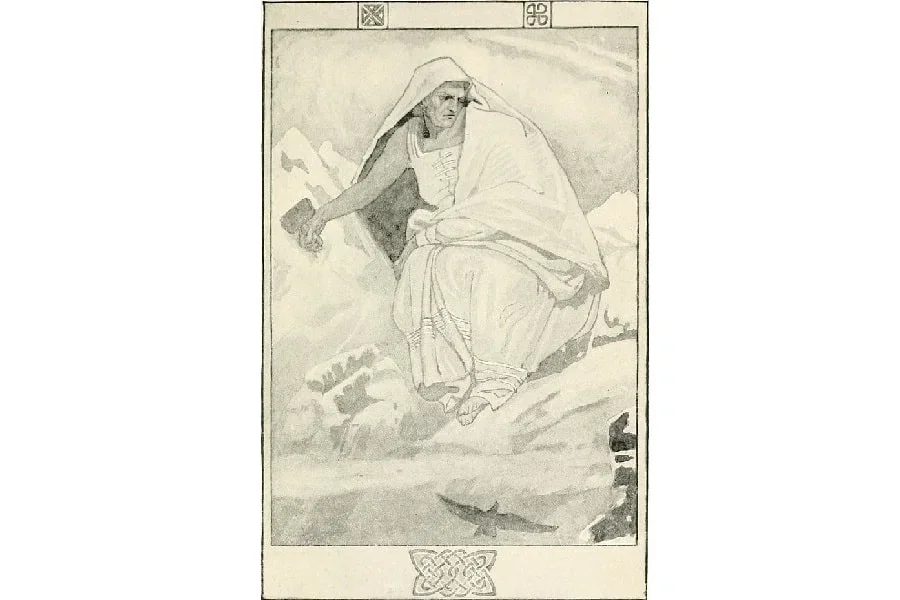
When it comes to her appearance, the most common description is that of veiled old women, often with only one eye and extremely pale or blue-tinged skin. Her clothing is seen as torn or ragged with an old cloak. When looking at figures from folklore and mythology, appearance is very often symbolic to the role that they have.
Cailleach is the Celtic goddess of winter, and her names means old and veiled. Her veil can represent both her role as a goddess and the mysteriousness of the ways of the gods, but it can also be seen to represent winter itself in the way that when winter arrives, it lowers a veil over the world with coldness and darkness. A coating of snow especially could be seen as a shroud over the land. Her pale or blue skin could be seen to represent the cold of winter when the frost or snow covers the land. Finally, her old, ragged clothing represents her as an old woman.
Cailleach is seen in Irish, Scottish, and Manx tradition and there are some differences. In the Manx folklore, she is said to be a shapeshifter with her preferred shape being a giant bird. Also in the Manx lore, she is said to spend the winter as an old woman, but once spring arrives, she would change back into a younger woman until the winter months arrive again.
This differs from the Irish tradition where she had ‘seven periods of youth’ following which she transformed permanently into an old woman.
Cailleach is seen as a ‘creator deity’ and is believed to have played a role in shaping the landscapes of the Celtic world, although some of this may have been unintentional. She is linked to storms, thunder, and the harshness of the elements which are also linked to changing the landscape with their ferocity.
Cailleach is not seen as completely good or evil; she is something in between. Whilst she is linked to the harshness of the weather found in the lands linked to the Celts, she is also seen as caring very deeply for animals. One thing that all of the Celtic traditions agree on is that she is the patron of wolves, and in Scotland she is known as a deer herder. Whilst she brings the cold and harsh conditions of winter, she also protects the animals seen out and about in the winter months.
Cailleach is also connected to grain, which was a resource that was relied on for people and animals to survive the harsh winter months. When the grain was harvested, the last sheath would be dedicated to Cailleach in thanks.
Sacred Sites
Cailleach has been related to a number of sacred sites, and to this day there is still a strong link between the goddess and these areas.
The Hags Head – This site is found on the southern tip of the Cliffs of Moher, in County Clare. At this site, there is a rock formation which is said to resemble a woman’s head, looking out over the sea from the cliff top. According to folklore, this is said to be Cailleach who is the Hag referred to in the name of the site.
The Hag of Beara Rock Chair is found at Cairn T, Sliabh na Calliagh, Loughcrew. In folklore it is said that Cailleach was taking part in a show of strength, and carrying an apron full of heavy stones, she leaped around the hills dropping them as she went which formed the cairns. The Rock Chair is said to be either her burial site as she died making the final leap to drop a stone, or it is the chair where Cailleach sits and waits for the arrival of the sea god, Manannán mac Lir, who was said to be her husband in some of the oral tradition stories.
In Cork, there is the Leaba Chaillí, or Hag’s Bed which is another site where Cailleach is said to be buried. At this site the remains of people were found, one adult male, a child, and a woman missing her head, which was placed in a separate part of the tomb, maybe as a sign that they were considered a witch.
In Scotland, she is connected to the Gulf of Corryvreckan, or in Gaelic, Coire Bhreacain. This is a whirlpool where Cailleach is said to wash her ‘ great plaid’ over three days during which the sound of a tempest could be heard for miles around. When Cailleach has finished washing, the tartan has turned to pure white and snow would be seen over the land. When Cailleach washes her great plaid, it is a sign that winter will begin.
Imbolc and Firewood
Imbolc takes place on February 1st and is seen as the time when Cailleach hands over the reigns to Brigid for the beginning of spring.
The stories tell us that on Imbolc Cailleach will be out and about collecting firewood to last her for the remainder of the cold weather.
If on Imbolc the weather is lovely and sunny, then it is bad news as it means that Cailleach has the time to collect a large amount of firewood and winter is not over as she intends to prolong the cold season.
However, if Imbolc has bad weather, then it is believed that Cailleach is asleep and therefore she will not be able to collect much firewood and spring will arrive soon.
The Wandering Friar and the Ox Bones
One story told about Cailleach is The Tale of the Wandering Friar and the Ox Bones from Irish folklore.
One winter, seeking shelter from the harsh winter weather, a wandering friar and his young scribe found themselves in the home of Cailleach. The friar, being a collector of knowledge, asked Cailleach how old she was. He had obviously never heard that it was rude to ask a lady how old she was!
Cailleach said that she did not know her exact age as she had lived for a very long time. However, it was her tradition to slaughter one oxen a year and keep the bones in her attic. Therefore, she reasoned, if they counted the number of bones in the attic, they would be able to reach a good estimate of her age.
The friar and his scribe had nothing else to do and so the scribe scrambled up into the attic to throw the bones down for the friar to count. The friar began to keep a tally of the bones as they were thrown down, but the pile of bones continued to grow until he ran out of paper to keep the tally on.
The friar called up to his scribe that he needed to stop as he had run out of paper already with the number of bones. The friar thought that there must be few bones left up in the attic, however, the scribe told him that he had not even cleared out one corner of the attic and there were still a huge number of bones left.
This story was used to emphasis how old Cailleach was and she was, in reality, a timeless figure who was linked to the seasons for as long as they existed. The story is also an important connection to Cailleach’s kinder side. Although she is linked to the harshest types of weather, she is also a provider and allowed the friar and his scribe to seek shelter and food in her home. This shows clearly the duality of her nature – a goddess of the harsh winter but also a nurturing deity who ensures that life is protected even in the harshest winters she brings.
Encounter with Fintan the Wise
Fintan mac Bóchra was also known as Fintan the Wise of the Hundred Lives due to his long life of over 5500 years. He arrived in Ireland alongside Cessair, said to be the granddaughter of Noah in a time before the flood.
When he arrived, he met Cailleach and realised that whilst he was a man who had lived a long time, she had lived even longer. They sat and talked about the cycles of life and the generations of people that they had seen in their long lives.
Cailleach spoke of her role as the goddess of winter and how important her role was in the cycles of the world. There needs to be a time when nature rested and prepared to renew for another year.
It is also said in some stories that Fintan asked Cailleach a question but did not receive an answer. He asked her, “Are you the one, the grandmother who ate the apples in the beginning?”
This would suggest that Fintan was implying that he believed that Cailleach may have been Eve and provides another link between the Celtic stories and early Christianity, which could be due to how the oral traditions were put into writing by the early Christian monks.